For enterprises processing large volumes of complex documents, document processing is not simply a back-office function. Accuracy, traceability and speed can have direct implications for downstream operations, regulatory workflows and business risk.
For a large enterprise operating complex, compliance-intensive processes, this challenge existed at significant scale: thousands of documents flowing across multiple locations, varied document structures, handwritten information, corrections and operational data that needed to be captured accurately and made available to downstream systems.
NexTurn has partnered with the enterprise throughout this transformation journey, progressively reengineering document processing from manual workflows to cloud-based OCR automation, and ultimately to AI-native document intelligence.
The Starting Point: A Document-Heavy Process at Enterprise Scale
Before intelligent document processing was introduced, document handling relied heavily on manual workflows.
Across 45 locations, more than 150 users scanned documents individually using desktop scanners and manually entered document identifiers. There was no effective batch capability, OCR was largely limited to extracting the printed document number, and downstream applications could wait hours to receive processed documents.
The legacy environment also had a hard processing ceiling of approximately 5,000 documents per day and depended on platforms carrying roughly $1.2 million in annual licensing costs.
NexTurn's first objective was therefore to establish a scalable digital foundation for document processing.
IDP 1.0: From Manual Processing to Cloud OCR Automation
NexTurn designed and implemented IDP 1.0 as a cloud-based intelligent document processing platform using Azure AI Document Intelligence.
Complete document packages could now be scanned through multifunction devices rather than processed one document at a time. AI automatically classified documents and extracted information, while a governed review workflow allowed users to validate document data before submission to downstream systems.
The first phase delivered substantial business improvements.
- Peak processing capacity increased from the legacy ceiling of 5,000 documents per day to approximately 6,400 documents per day.
- Downstream handoffs that previously took hours could happen in seconds.
- The redesigned solution also removed dependencies on legacy CRM, ServiceMax and ccScan components, eliminating approximately $1.2 million in annual licensing costs.
IDP 1.0 established a strong automation foundation. But as the solution operated in production, the limitations of conventional OCR became increasingly apparent. At the same time, advances in Generative AI created an opportunity to approach document intelligence differently.
Why OCR Was No Longer Enough
OCR is highly effective at recognizing characters. Complex enterprise documents, however, require more than character recognition. They require an understanding of structure, relationships, corrections, context and sometimes human intent.
Traditional OCR presented three important constraints.
- Extraction was closely tied to document layouts and templates. Changes in document structures or field positions created additional configuration and model-maintenance effort.
- OCR could recognize text within tables and structured sections but often lose the semantic relationships that made the information meaningful. A structured line-item table, for example, could become a flattened string requiring further interpretation.
- Handwritten changes, annotations and corrections remained difficult to interpret reliably.
Actual production examples made these limitations tangible – a date written as “12-7-23” could be extracted as “12 723”, despite high OCR confidence. The digit “0” in a line-details table could be interpreted as the letter “O.” Struck-through information could be captured as valid content alongside the intended correction.
These were not simply character-recognition problems. They required the system to reason about what the information meant within the document. That became the catalyst for IDP 2.0.
IDP 2.0: From Extraction to AI-Native Document Intelligence
NexTurn reengineered the extraction layer around a GenAI-powered, schema-driven approach.
Instead of maintaining rigid, per-template OCR extraction, IDP 2.0 uses a defined JSON schema to describe the information required and applies GenAI reasoning to understand the document's content and structure.
This fundamentally changes what document processing can do.
- Tables and line items can retain their structural relationships rather than being reduced to flattened text.
- Process data, entity details, identifiers and other fields can be returned as structured data.
- Handwritten information and document variations can be interpreted contextually.
- Crossed-out content can be understood as an intentional correction rather than treated as valid information.
In other words, the platform moves beyond simply reading documents toward reasoning over them.
Inside the AI-Native Architecture
Productionizing that intelligence required much more than connecting an enterprise workflow to an LLM.
IDP 2.0 was engineered on the Databricks Data Intelligence Platform, bringing data processing, AI orchestration, governance, evaluation and observability into an integrated architecture.
- Declarative Lakeflow Pipelines manage document ingestion and transformation, supporting scalable movement of documents through the processing lifecycle.
- Claude Sonnet 4.0, deployed through Databricks Model Serving, provides the contextual reasoning required to interpret complex document structures, handwritten information, corrections and variations.
- LlamaIndex Agentic Workflows orchestrate the AI processing flow, coordinating specialized stages of document interpretation, extraction and exception handling.
- MLflow and Unity Catalog support model management, governance, lineage and production traceability.
- Databricks Asset Bundles, combined with CI/CD automation, enable consistent deployment across development, staging and production environments.
The architecture also incorporates detailed observability across document pickup, preprocessing, extraction and persistence, together with proactive error classification to accelerate operational triage.
The objective was not merely to build an AI extraction capability. It was to engineer an observable, governed and production-ready AI system capable of operating inside a mission-critical enterprise workflow.
Measuring AI Where It Matters: In Production
AI performance can look compelling in a proof-of-concept (POC). The more important question is how it behaves against real production data.
NexTurn therefore built evaluation and measurement into the IDP 2.0 lifecycle.
The IDP 1.0 production environment provided the baseline across measures such as field-level extraction accuracy, manual correction effort, intervention rates and processing performance.
IDP 2.0 was then evaluated against that baseline across more than 10,000 production documents.
- Offline AI evaluations benchmark outputs against ground truth before changes reach production.
- Online evaluations use custom evaluation rubrics and LLM-as-judge techniques to monitor quality during operation.
- Schema validation, field-level analysis and error tracking provide additional quality controls.
This evidence-based approach allowed the team to measure the impact of GenAI against the system it was replacing and not against an artificial laboratory benchmark.
Quantitative & Strategic Impact
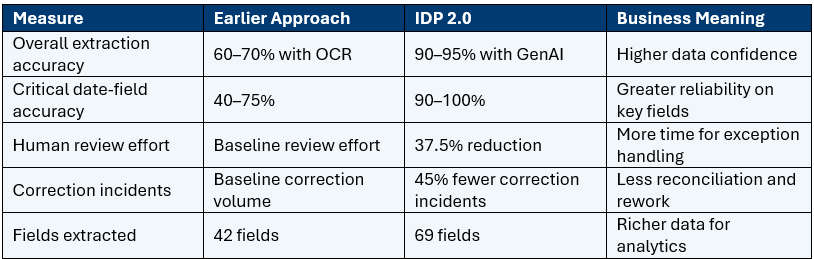
The transition from OCR-based extraction to GenAI delivered measurable improvements, but the significance of those improvements goes beyond the headline numbers.
Higher Accuracy and Greater Data Confidence
- Overall extraction accuracy increased from approximately 60–70% with OCR to 90–95% with GenAI.
- For critical date fields, accuracy improved from approximately 40–75% to 90–100%.
In a workflow where document information feeds operational and compliance processes, better extraction means greater confidence in the data moving downstream and a lower likelihood of document-processing errors creating subsequent reconciliation or regulatory issues.
37.5% Less Human Review
Manual intervention decreased by 37.5%. Rather than requiring people to spend as much time reviewing routine extraction output, the workflow can concentrate human attention on cases where judgment or exception handling is genuinely required. The goal is applying human expertise where it creates greater value.
45% Fewer Correction Incidents
Correction incidents declined by 45%, reducing reconciliation and rework. This is particularly important in a compliance-sensitive workflow. Cleaner information at the point of extraction improves downstream data quality while reducing the operational effort required to identify and correct discrepancies.
Richer Data: 69 Fields Instead of 42
IDP 2.0 expanded extraction from 42 fields to 69 fields per document. That additional structured information does more than improve document processing. It creates a richer data foundation for analytics, reporting, performance monitoring and future process optimization.
Template-Agnostic Flexibility
IDP 2.0 reduces dependence on rigid document templates – where OCR-based approaches required additional effort when document layouts changed, schema-driven GenAI can reason over variations in content and structure without requiring a separate extraction model for every layout.
That flexibility reduces maintenance overhead and makes the platform better suited to an environment where document formats continue to evolve.
Production-Ready Observability and Governance
Production-grade AI requires visibility into system performance, output quality, processing exceptions and traceability across the workflow.
IDP 2.0 addresses these requirements through end-to-end metrics, error tracking, AI evaluations, lineage and governance.
This operational visibility helps transform GenAI from an experimental capability into an enterprise-grade system that can be continuously monitored, evaluated and governed in production.
Shifting Human Effort to Higher-Value Work
Reducing manual reviews and correction cycles changes the role people play in the workflow.
Operations teams can devote more attention to genuine exceptions, process improvement and analysis rather than routine extraction validation and repetitive correction.
That represents an important dimension of AI-native transformation: using AI not merely to automate individual tasks, but to redesign how human expertise is applied.
What the Field-Level Evidence Shows
A weekly comparison of GenAI IDP and OCR showed substantially fewer corrections across several compliance-relevant fields. The strongest improvements were visible in areas such as handwritten signatures and management-method codes, while date fields also demonstrated meaningful gains.
The comparison is particularly valuable because it demonstrates where contextual AI reasoning changes the workflow in practice – not merely as an overall accuracy percentage, but at the level of individual data elements being processed every day.
6 Engineers. 3 Months. Zero Downtime.
The technology is only one part of the IDP 2.0 story. How it reached production is equally important.
A focused NexTurn team of 6–8 engineers took IDP 2.0 from POC to production in three months.
Rather than introducing the new platform through a disruptive replacement program, the team executed an in-situ hot switch, bringing IDP 2.0 into the production environment with zero downtime during the transition.
- This required more than rapid development.
- Evaluation had to be embedded into the engineering lifecycle.
- Production edge cases had to be solved.
- Deployment had to be repeatable.
- Observability had to be available from day one.
And the new AI-driven workflow had to coexist with the operational reliability expected from an established enterprise process.
Moving quickly mattered. Moving quickly without compromising production discipline mattered more.
Co-Innovation with Databricks
IDP 2.0 also became an example of engineering collaboration extending beyond conventional platform implementation.
NexTurn worked closely with the Databricks Resident Architect group during the engagement, particularly around production considerations such as Model Serving optimization and pipeline performance.
Some of the challenges encountered at production scale extended beyond existing documentation. NexTurn engineers worked through these edge cases and shared implementation insights back with Databricks. That collaboration helped the team use emerging platform capabilities in a demanding production environment while contributing practical learnings from the implementation.
For NexTurn, this is an important aspect of AI engineering maturity: not simply consuming AI platforms but working deeply enough with them to solve production problems at the frontier of their capabilities.
Recognized for AI/ML Innovation
The impact of IDP 2.0 has also received external recognition – the solution was recently named AI/ML-Driven Data Solution of the Year at the BW Businessworld Chief Data & AI Officers Conclave & Awards 2026.
The recognition reinforces what the production results already demonstrate: enterprise GenAI creates meaningful value when advanced AI capabilities are combined with rigorous engineering, measurable outcomes and a clear business problem worth solving.
Looking Ahead: An Extensible Document Intelligence Foundation
IDP 2.0 is not the end of the document-intelligence journey.
Its architecture and richer data foundation create opportunities to extend intelligence further across the document lifecycle.
Future capabilities can include:
- Deeper analytics using the expanded 69-field dataset.
- Automated operational reporting.
- Intelligent correlation across related documents.
- Proactive identification of unusual patterns or data-quality issues.
- Feedback loops that continuously strengthen system performance.
The significance of this architecture therefore extends beyond today's extraction workflow. It creates a foundation on which additional AI-driven capabilities can be engineered as business requirements evolve.
From AI Experimentation to AI-Native Operations
The evolution from manual scanning to cloud OCR and ultimately to GenAI illustrates an important principle about enterprise AI.
IDP 2.0 was created because an established production system had reached limitations that a new generation of AI could address differently. And the transformation did not stop at demonstrating that an LLM could understand a document.
The intelligence was engineered into a governed production workflow. Its performance was measured against a real baseline. It was deployed without disrupting operations. And its impact is visible in higher accuracy, fewer corrections, reduced human review and richer enterprise data.
That is the difference between using AI and becoming AI-native.
For NexTurn, that distinction defines the opportunity ahead: applying AI where it can fundamentally reengineer enterprise processes and carrying those ideas all the way from possibility to measurable production value.
NexTurn helps enterprises redesign complex operational workflows around AI, engineering and human expertise – turning intelligence into measurable business outcomes.
Write to us at marketing@nexturn.com.
Explore more at https://nexturn.com